




UTRC follows the reporting requirements set forth by the U.S. Department of Transportation's Research and Innovative Technology Administration (RITA). The purpose of these reports is to share the funded research results available for the transportation professionals and researchers and to publish the center’s past and future activities in the education, workforce development and technology transfer programs.
UTRC publications include a variety of reports; Project Reports, Project Briefs, Journal Articles, Quarterly Newsletters, Annual Reports, and Conference Reports. These reports can be accessed using the search tool which filters publications by the report type, publication year, principal investigator, and research topics.
|
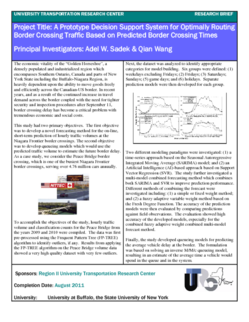
Title: A Prototype Decision Support System for Optimally Routing Border Crossing Traffic Based on Predicted Border Crossing Times Author(s): Publication Year: 2011 The economic vitality of the 'Golden Horseshoe', a densely populated and industrialized region which encompasses Southern Ontario, Canada and parts of New York State including the Buffalo-Niagara Region, is heavily dependent upon the… |
|
Title: Analysis of Bicycling Trends and Policies in Large North American Cities: Lessons for New York Author(s): Publication Year: 2011 0 |
|
Title: Barricade Lighting System Author(s): Dr. Mark Rea, Dr. John Bullough Publication Year: 2011 <p>Barricade warning lights have been used for many years at construction sites to indicate to drivers that caution is needed. A benefit of these warning lights is that they are widely recognized and understood, but a downside is that &… |
|
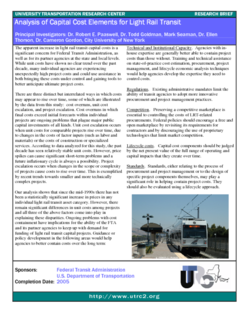
Title: Analysis of Capital Cost Elements for Light Rail Transit Author(s): Publication Year: 2005 The apparent increase in light rail transit capital costs is a significant concern for Federal Transit Administration, as well as for its partner agencies at the state and local levels. While unit costs have shown no clear trend over the past… |
|
Title: Collaborative Exploratory Research on the Anticipatory Route Guidance Problem Author(s): Publication Year: 2006 Advanced traveler information systems (ATIS) attempt to provide drivers with data intended to help them make better travel decisions. Messages may be available to all drivers (for example by radio or television broadcasts) or only to some: for… |